%201.png)
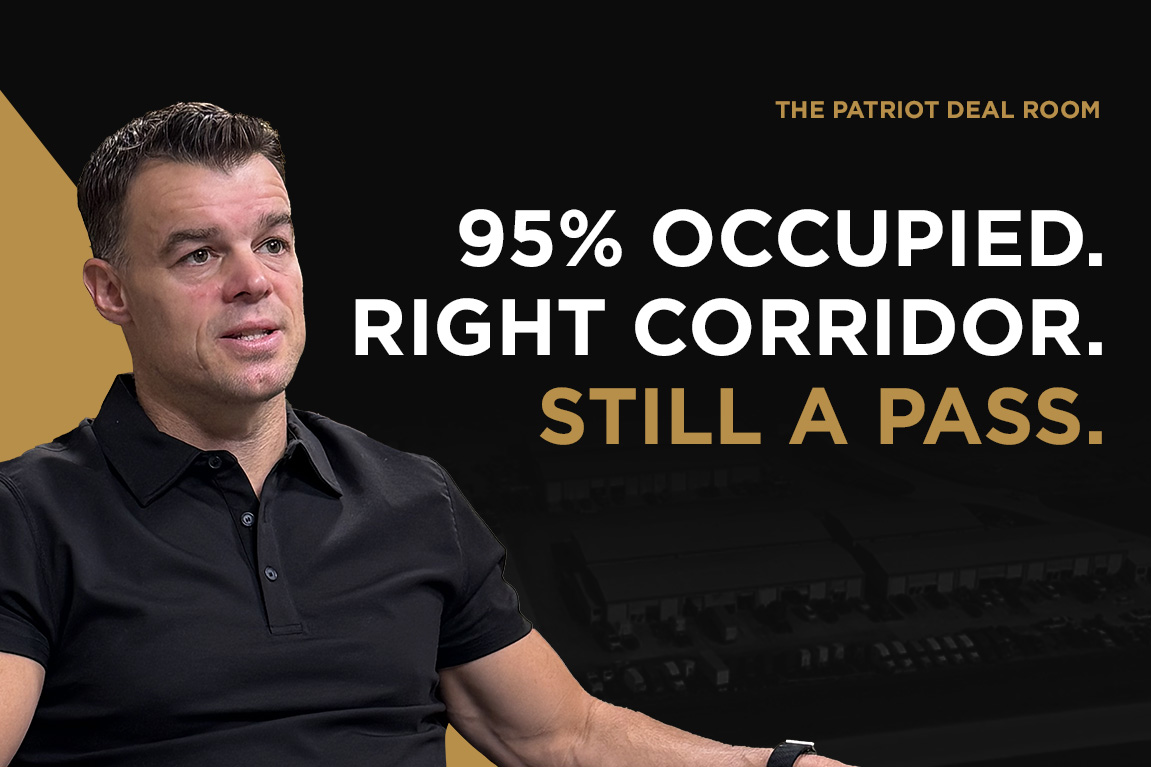
Why I Passed on a 95% Occupied Small Bay “Flex” Industrial Deal
WELCOME TO THE PATRIOT DEAL ROOM, Issue No. 01
Most real estate content is written by people who don't buy real estate. I do, and I have for more than 20 years. So here is what this series is instead.
Every issue is one real deal we underwrote, framed one of two ways: why I passed, or why I bought. Real numbers. Real operating expenses. Real property tax reassessments that quietly kill returns. I will show you the broker's operating statement, then show you how we rebuild it line by line into what the property actually costs to run.
Every issue follows the same skeleton: the deal snapshot, what I liked and what I didn't, a Seller Motivation Check, a read of the P&L like an operator, and the verdict. One filter runs through all of it: protect capital first. Every deal gets evaluated on how to protect the downside first. What breaks it? What assumptions have to be made for this property to truly pencil? Are the risk-adjusted returns worth taking the risk at all?
For context: Patriot Holdings is a commercial real estate private equity firm with more than $435 million in assets under management across three asset classes, self-storage, manufactured home communities, and small bay “flex” industrial. Over two decades, I have bought more than $1 billion of real estate. Across our realized deals, we have averaged 20%+ IRR and a 2x+ equity multiple. I am not sharing to celebrate past wins. I am sharing so you know the deals in this series are not theoretical. They are the actual pipeline crossing my desk.
Deals we don't currently own are anonymized, out of respect for confidentiality with brokers and owners. The lessons are not. Let's dive in.
"Most of what you learn in this business comes from the deals you walk away from." - Jeremiah Boucher

THE DEAL
This one came to us off-market: a small bay “flex” industrial park in an exurban growth corridor northwest of Fort Worth. On paper, exactly what we buy. I passed. Here is the honest breakdown, real numbers included.
.jpg)
WHAT I LIKED
Right product, right corridor. Small bay flex is the most supply-constrained segment of industrial, and this sits directly in the path of DFW's northwest expansion. Contractor and service-tenant demand in the area is real.
The size and unit mix are exactly right. 69,150 SF is real scale for this asset class, and suites run from 1,250 SF up to 10,000 SF. That range serves everyone from the one-truck contractor to the growing regional operator, and it is what creates a genuinely diverse 17-tenant mix with steady 3% annual escalations. Durable income without heroic assumptions. That is the profile we buy.
The heavy building work is done. Newer construction with a fresh exterior renovation: paint, facade, awnings, doors. The buildings show well and there is no surprise roof issue in year two.
WHAT I DIDN'T LIKE
The taxes haven't been reassessed to where Texas will take them. This is the headline issue. The OM underwrites $78K in property taxes, the seller's old basis, not yours or ours. Texas reassesses on sale, and at a $10.37M purchase price that line lands closer to $230K to $250K. Yes, that is an aggressive reassessment, but it is typical of Texas. And here is the part that kills the deal: even if the increase comes in at half of what we are calculating, you are still losing more than $80K of NOI at closing.
The pricing expectation doesn't match the rents, or the product. $150/SF is not a deal killer on its own. I will pay it when the income supports it. But at $10 NNN market rents, that price is too aggressive. And the product isn't finished: portions of the drives are still gravel. That drags down the quality of the asset, and paving it is a significant capex check the next owner writes, both to stay competitive long term and to bring maintenance costs down. I am not paying a finished-product price and then finishing the product myself.
The submarket is too thin to backfill. Let me be clear: the 1.7-year WALT does not bother me. In small bay, short leases are a feature. They are your mechanism for rent increases and your flexibility to re-lease to a better user. What bothers me is where you would be doing it. This is 30 to 35 minutes outside downtown Fort Worth, in a market of maybe 2,000 to 3,000 people. Lose a few tenants and backfilling gets very difficult in the short term. It is a good long-term play as the corridor grows, but I don't want to pay for all of that value upfront and wait a decade to realize the real gains.
SELLER MOTIVATION CHECK
Every deal we break down in The Deal Room gets this check, because it is the most underrated variable in real estate: why is the seller selling?
Here: no distress, no debt maturity, no partnership breakup, no life event. They built this recently, they have a good basis, and they are simply trying to max value at the top of the market. That matters for two reasons.
You have no negotiating leverage. An unmotivated seller doesn't need your offer. The price only moves if the market tells them "no" for long enough, and you don't want to be the buyer who says "yes" first.
You're buying at their cap rate, not the market's. They are asking a 6.3% cap rate today for an asset that will probably trade north of a 7% cap down the road. Quick translation for anyone newer to cap rate math: a cap rate is the property's annual net income divided by its price, and price moves inversely to the cap rate. The same NOI valued at a 7% cap is worth roughly 10% less than at a 6.3% cap. So if cap rates drift from 6.3 to 7-plus over your hold, you need years of income growth just to claw back to the price you paid.
Motivated sellers create discounts. Unmotivated sellers create traps. This was the second kind.
READ THE P&L LIKE AN OPERATOR
Brokers love to shrink the expense load. It is how a 5-cap deal gets dressed up as a 6.3. This operating statement is a textbook example. Here is what the OM printed, and what it actually takes to run the property:
.jpg)
Roughly $62K a year of missing operating expenses before you even touch the tax line. Stack the reassessment on top and the broker's $652K NOI becomes $427K to $508K on day one. Put plainly: you would be paying a 6.3% cap rate for an asset that actually operates at a 4.1% to 4.9% cap rate.
And before anyone says it is NNN, just pass the expenses through: every dollar you pass through raises your tenants' total occupancy cost, which makes you less competitive on rents in a rural market. Triple net is not a magic eraser.
THE VERDICT
.jpg)
THE LESSON
.jpg)
Subscribe to the weekly newsletter
The Patriot Deal Room breaks down real deals we underwrite at Patriot Holdings, the ones we buy and the ones we don't. New issues publish every Wednesday. Follow along or reach out if you want to see what we are buying right now.
Start The Conversation
This content is for educational and informational purposes only and does not constitute an offer to sell or a solicitation of an offer to buy any security, nor investment, legal, or tax advice. The deal described has been anonymized and is not owned by Patriot Holdings or its affiliates. Performance figures, including references to assets under management, aggregate acquisition volume, internal rate of return (IRR), and equity multiple, reflect realized results across selected prior investments, are not audited, are not presented net of all fees and expenses, and do not reflect the experience of any individual investor. Past performance is not indicative of future results. All investments involve risk, including the possible loss of principal. Any private investment offering is available only to verified accredited investors pursuant to the applicable offering documents, which govern in all respects.