%201.png)
Where to Invest in Flex Industrial: The MASM Filter
My philosophy on where to invest has changed as I have bought and sold more than $1B of assets throughout my career. Early on, I bought many small assets in many small markets. Places like Winnemucca, Nevada. There is nothing wrong with this town, but I have a different view now. I take a long-term view and that has pushed me toward large markets or suburban, growth corridors supporting those large markets that will keep growing regardless of the economy. Markets like Dallas, Houston, Boston, and Philadelphia. These places have population, stability, jobs, and steady demand for affordable real estate. That last part matters most, because it is the businesses in these markets that need space to serve their customers.
What is the MASM filter?
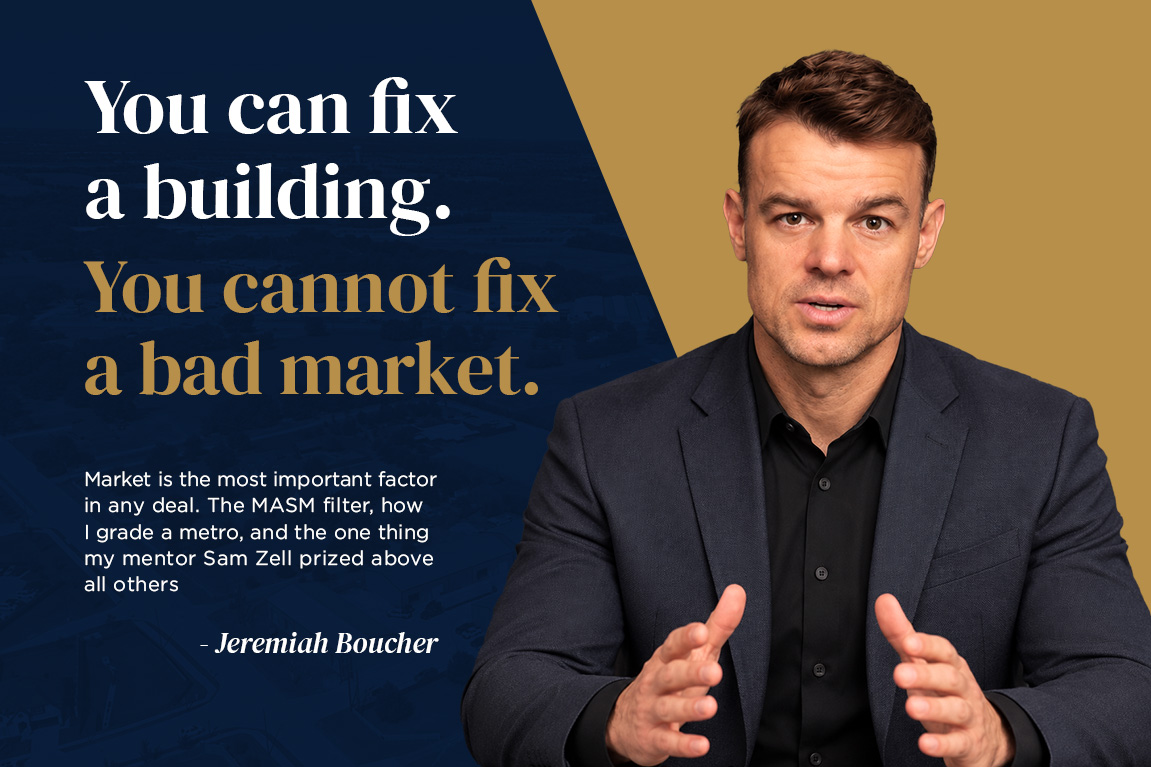
Every deal I look at goes through the same screen. I call it MASM: Market, Asset, Seller, and Management. Market comes first for a reason. It is by far the most important. You can fix a tired building. You can wait out a difficult seller. You cannot fix a bad market. If the market is wrong, essentially nothing else you do will save the deal. This chapter is about that first "M". Get the market right, and you have earned the right to look at everything else.
Start at 30,000 feet: jobs and people
When I evaluate a market, I start from the top. And it always comes back to two things: jobs and people. Real estate is jobs, location, and people. That is the whole equation. You need people who have income, and you need them supported by good infrastructure. And, ideally the property's infrastructure includes some inherent visibility. When I look at a metro, I ask a short list of questions. Is there easy transportation, with highways and airports? Are there hospitals and quality retail? Are there strong schools? Is there quality housing? And most important of all, are there dependable jobs from industries and employers with staying power?
Answering these questions takes common sense and data, combined. The best value I find for flex sits in the inner-city and suburban feeder markets of these large metros. I stay away from rural and tertiary markets, because the demand is often too soft and the rents do not always justify the cost of building.
How do you grade a market?
The investment community grades markets on a rolling scale, from the smallest and riskiest up to the largest and most stable. Here is the version I use:

Large, diversified, growing metros like Dallas, Houston, Boston, and Philadelphia.
- Deep, institutional buyer pool.
- Strong, durable long-term demand.
- Large, diversified economy.

The growing suburbs and exurbs of those metros.
- Solid, broad liquidity.
- The demand of the big market with better basis than the urban core.
- My sweet spot.

Mid-size metros with a real job base.
- Selective, and only with the data behind it.
- Watch the diversity of the employment base.
- Can work, but be disciplined.

Small, often one-industry towns.
- Thin, hard to exit.
- Soft demand, and rents do not justify the build.
- Avoid.
As you move down that scale, the risk goes up and the potential liquidity goes down. In a tertiary market you might buy at a great price, but when it comes time to sell, the buyer pool is thin and you can be stuck. In a core or suburban feeder market, there is always someone on the other side of the trade.
Which signals matter beyond the basics?
- Path of progress. I want to buy in the direction a metro is growing, ahead of the new highways, interchanges, and rooftops.
- A diversified employment base. I do not want a market that lives or dies on a single employer or industry. Many engines are safer than one.
- Net in-migration. Are people and companies moving into this market or out of it? Growth covers a lot of mistakes. Decline exposes them.
- Landlord climate and insurance cost. How fast can you enforce a lease? How business-friendly is the state? And what does property insurance cost, which has become a real swing factor in coastal and hail-prone markets?
- Small business formation. The more new businesses forming in a metro, the more of my exact tenant is being created every year.
Where inside a market should you buy?
Once the market checks out, location preference moves in a clear order. Main and Main is the ideal: a high-visibility corner with heavy traffic. You will not get it most of the time, but when you can, it is by far the best location you can own. Never downplay drive-by traffic for this asset class. Visibility leases space. Next best is near quality housing, because most of your flex tenants serve the local population within about a 30-minute drive, and the business owners themselves want to live nearby. After that, near larger industrial areas, where big distribution and manufacturing centers rely on a web of smaller subcontractors and suppliers to keep running. Own the small bay space near a major industrial hub, and you are housing the affiliate ecosystem that hub depends on.
Why replacement cost decides everything
Now the factor I will harp on more than any other. My mentor Sam Zell defined supply, demand, and replacement cost as the single most important thing to analyze in any real estate investment, and I agree completely. The goal is to buy in markets where it is very hard to add new supply. And if you can buy below replacement cost, even better. Because when your basis sits below what it would cost to build the same thing new, no new development can undercut your rents and kill your investment. The new guy has to charge more than you just to break even.
I learned the opposite lesson watching the self-storage industry. Too much supply gets built in a hot market, and returns suffer for everyone. So do the work. Know, within about a 10-mile radius, who your competition is and what it costs per square foot to develop a comparable asset. Once you know the cost to build, you can back into the rents a new developer would have to charge to make their numbers work. If those rents are well above what you charge, you are protected. The rule of thumb is simple: the less supply the better, as long as the population is there to support demand.
You can fix a building. You cannot fix a bad market. That is why Market is the first "M" in the MASM filter, and the one you never compromise on. — Jeremiah Boucher
When we move into a newer market, like North Dallas where we are active now, the play is to get in early and at a below replacement cost basis. Being first to market is a real advantage: we fill our parks, we establish our rents, and we can adjust from a position of strength. Next in the series: once you have the market, do you acquire or develop?
Subscribe to the weekly newsletter
Start The Conversation
Join The Waitlist For The New Book
Compliance disclosure
For informational purposes only. This is not investment advice and not an offer to buy or sell any security. Past performance is not indicative of future results. All investments involve risk, including the possible loss of principal.