%201.png)

New Acquisition: Rockland, MA - 45,510 SF. Six Years. Zero Competing Bids.
"Why we like it? Strong basis. Verified mark-to-market on both income streams. Below-market seller financing and a day-one credit that pull returns forward. Conservative rent and exit assumptions. And a location inside the Boston MSA where storage and small-bay demand is historically durable and new supply is structurally constrained. Rockland is a strong asset and a great foundation: cash-flowing from day one, with a clear, executable path to further mark rents to market over the hold." - By Jeremiah Boucher, Founder & CEO, Patriot Holdings

DEAL SNAPSHOT
- Property: Rockland Storage & Industrial, 265 Pleasant Street, Rockland, MA
- Market: Boston MSA, South Shore
- Asset type: Mixed-use: self-storage and small-bay industrial
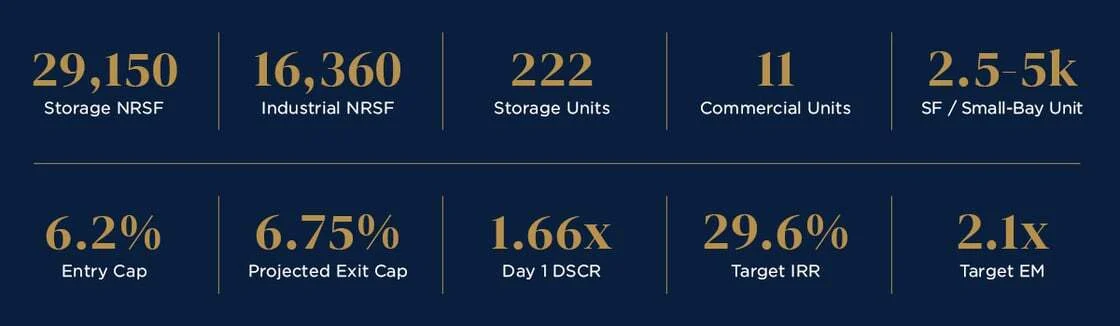
- Total size: 45,510 SF (29,150 SF storage | 16,360 SF industrial) on ~4.7 acres
- Year built: 2003
- Closed: July 17, 2026
- Purchase price: $4,500,000 (~$99/SF)
- Total capitalization: $5,095,252 (~$112/SF)
- Going-in cap rate: 6.25% ($281,060 adjusted NOI / $4,500,000)
- Total debt: $4,125,000 (~81% of total project cost) at a ~6.2% blended fixed rate
- Sourcing: Off-market, direct from seller, six-year relationship
Read the full acquisition memo.
The Best Deals I Have Bought Were Never For Sale
Rockland is one of the clearest examples I can point to in Fund V.
We first knocked on this door more than six years ago. The property was not listed. There was no broker, no offering memorandum, and no particular reason for the owner to take our call. So we did the only thing that works in that situation. We stayed close. Periodic visits. Consistent follow-up through every turn of the market. And a reputation, built one closing at a time, for performing on exactly the terms we commit to.
Six years later, when the owner was finally ready, there was no auction and no competing bids. The deal came directly to us.
What Did Fund V Buy?
On July 17, 2026, Fund V closed on Rockland Storage and Industrial at 265 Pleasant Street in Rockland, Massachusetts, on the South Shore inside the Boston MSA. It is a 45,510 SF mixed-use asset built in 2003, sitting on roughly 4.7 acres, running two separate income streams under one roof line:
Self-storage: 29,150 SF, currently 85% physically occupied.
Small-bay industrial: 16,360 SF of a product type that is scarce and rarely built new anywhere in the Boston MSA.
%20NEW2.jpg)
We paid $4,500,000, or about $99 per square foot. Total capitalization, which funds the purchase plus closing costs, the CapEx program, tenant improvements and leasing costs, and operating reserves, is $5,095,252, or roughly $112 per square foot all in.
The going-in cap rate is 6.25%. That is the seller's adjusted net operating income of $281,060 divided by the $4,500,000 purchase price. I want to show that division rather than assert the result, because a cap rate without its numerator is just a marketing figure.
The location does real work here. Within three miles, median household income runs about $112,000 and median home values about $549,000. Storage demand against that household profile has been historically durable, and new supply in this submarket is structurally constrained. Land in metro Boston is expensive enough that small-bay industrial rents do not justify new construction. Existing product is effectively the only product.
A Seller Who Stayed in the Deal Behind Us
The relationship did not stop at the purchase price. It carried into the capital structure.
The seller took back a $750,000 second mortgage at 5.00% fixed, interest-only for its full five-year term. That sits behind a $3,375,000 bank first mortgage at 6.45% fixed on a ten-year term, 75% LTV, with 24 months of interest-only and a 25-year amortization. Total debt is $4,125,000, which is about 81% of total cost. Weighted across both notes, our blended cost of debt is roughly 6.2% fixed, and day-one debt service is covered about 1.65x by in-place income.
A seller who finances roughly 17% of the purchase price at 5.00% fixed, in second position, is telling you something worth hearing. He is not trying to get out of this asset. He is standing behind us because he expects the buyer to perform. The seller also executed a leaseback for one of the commercial units over an extended term.
We also negotiated approximately $180,000 of day-one credits: a $150,000 credit representing roughly three years of rent support on the commercial component, plus a $30,000 prepaid industrial tenant payment. Those credits compensate the Fund while legacy leases roll toward market, rather than us waiting years to capture that income.
Where the Value Is: A Mark-to-Market We Can Defend
Both income streams carry in-place rents well below market. That is not a distress signal, and I want to be careful how it gets read. It is the signature of long-term private ownership that valued occupancy and tenant relationships over pushing rate at every renewal. I have real respect for how this property was run. It also means the gap is genuine and collectible.
Self-storage: in-place rents of $11.70/SF against a verified market of $16.00/SF. That is a mark-to-market gap of about 37%. Physical occupancy sits at 85% against our underwritten stabilization of 90%, so there is a lease-up lever stacked on top of the rate lever.
Small-bay industrial: effective day-one rents of about $11.75/SF against a verified market of $18.00/SF, a gap of roughly 53%, captured through a structured program as leases turn.
%20NEW2.jpg)
Here is the part I want investors to hold onto. We do not underwrite to today's market. Even at the end of the hold, our model has storage reaching only $14.99/SF against the $16.00 the market pays today, and small-bay reaching only $17.05/SF against $18.00 today. We are projecting rents below what the surrounding market already pays, before any future growth at all. Every dollar in that gap is unpriced in our numbers. If we sell into it, the next owner still inherits a mark-to-market story, which is exactly the position you want to occupy as a seller.
“We do not underwrite to today's market. Even at the end of the hold, we are projecting rents below what Rockland's market already pays right now.” - Jeremiah Boucher, Founder & CEO, Patriot Holdings
The two asset classes also hedge one another. Storage and small-bay industrial respond to different demand drivers, and we own both on a single basis.
What the Equity Is Actually Buying
There are two equity numbers in this deal, and conflating them would be easy, so let me separate them plainly.
Day-one equity against the raw purchase price was $375,000. That is simply the $4,500,000 price less $4,125,000 of debt. Total equity, fully loaded, is $970,252, or about 19% of total cost. It breaks down like this:
Purchase equity - $375,000 ($4.5M price less $4.125M of debt)
Closing costs (modeled) - $251,620 (actual per settlement: $274,682)
CapEx program - $222,870 (physical plant and site work)
TI and leasing costs - $78,252 (small-bay lease turnover)
Operating reserves - $42,510 (held against operations)
Total equity, fully loaded - $970,252 (~19% of total cost)
The second number is the honest one, and its composition matters more than its total. About 61% of the equity in this deal is funding the work rather than the entry price. That is what a value-add basis is supposed to look like.
One note in the interest of transparency. Actual closing costs on the settlement statement came in at $274,682, roughly $23,000 above the $251,620 we modeled. We expect that variance to be balanced by lower leasing commissions and reserve requirements across the program, which is why the modeled equity total remains our operating basis.
Three Questions Every Value-Add Investor Should Ask
What makes a mark-to-market opportunity defensible rather than speculative?
A defensible gap is measured against verified comparables that the surrounding market is paying today, within a tight radius, not against a projected rent curve. If the plan requires the market to move before the thesis works, that is a growth bet. If the plan only requires existing rents to move toward what neighbors already collect, that is an execution plan. The two carry very different risk profiles.
Why does seller financing matter beyond the interest rate?
Rate is the obvious benefit. Alignment is the larger one. A seller who accepts a second-position note is accepting subordinated risk on an asset he knows better than anyone. That is a signal about the property and about his read on the buyer. It also reduces the senior debt required at entry, which changes the shape of the whole capital stack.
What should you look for in a dual asset class property?
Look for two demand drivers that do not move together, sitting on one basis and one set of fixed costs. Then confirm that each component can be underwritten independently. If the deal only works because you blended the two into a single average, you are hiding a weak stream inside a strong one.
Why Rockland Fits Fund V
Rockland is a clean expression of what we underwrite for across the Fund V portfolio. Relationship-driven sourcing that produced a basis a competitive process would not have produced. A structure negotiated at the closing table rather than hoped for in a pro forma. And a value creation plan that depends on execution we control rather than market movement we do not.
Relationships create returns. Rockland took six years to prove it.
Read the full acquisition memo.
Get the next deal dive in your inbox. Subscribe to the Patriot Holdings newsletter for weekly acquisition breakdowns, underwriting notes, and the Why We Passed series.
Subscribe to the weekly newsletter
Patriot Holdings is a commercial real estate private equity firm investing in flex industrial, self-storage, and manufactured home communities across secondary U.S. markets. Founded and led by Jeremiah Boucher, the firm sources relationship-driven, off-market transactions and operates them for long-term cash flow and appreciation.
Start The Conversation
COMPLIANCE DISCLOSURE
This post is for informational and educational purposes only. It does not constitute an offer to sell or a solicitation of an offer to buy any security. Any securities offering by Patriot Holdings is made solely pursuant to Rule 506(c) of Regulation D and is available only to verified accredited investors as defined under Rule 501 of Regulation D, and solely through the Fund V offering documents, which control in all respects. Property-level figures presented above, including purchase price, capitalization, in-place rents, occupancy, debt terms, and negotiated credits, reflect the transaction as closed on July 17, 2026 and Patriot Holdings' underwriting as of the date of publication. References to verified market rents reflect Patriot Holdings' review of comparable properties and represent our assessment, which other qualified operators may reasonably dispute. Statements regarding future rents, occupancy, net operating income, hold period, exit assumptions, and returns are forward-looking estimates based on underwriting assumptions, are subject to change, and are not guarantees of future performance. Actual results may differ materially. Past performance is not indicative of future results. All investments involve risk, including the possible loss of principal. Nothing herein is investment, legal, or tax advice. Consult your own advisors regarding your specific situation.