How Patriot Targets 200%+ Cumulative Depreciation
There is a moment on almost every call our CGO, Rick Cherry, has with a new investor about Fund VI. He explains the first year of bonus depreciation, and the investor nods. Then he explains the second year, on the same money, and the investor stops him.
"Wait. I could get another 100% next year? On the same equity?"
Close to it. That reaction is why we wrote this post.
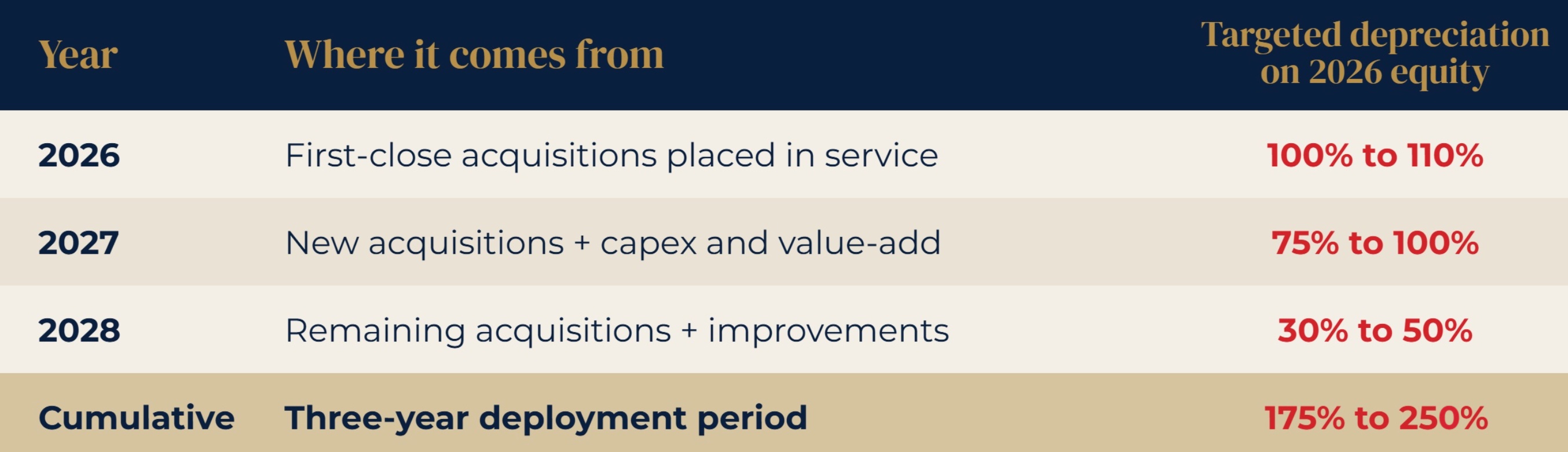
Fund VI targets cumulative depreciation of 175% to 250% per dollar invested over its three-year deployment period: roughly 100% to 110% is targeted in 2026, another 75% to 100% is targeted in 2027, and another 30% to 50% is targeted in 2028, all on the same 2026 equity. Most real estate deals deliver one big depreciation year and then often fade. They accelerate most of what they can in the first year. Here is how Fund VI is built differently.
“Turning away money is the hardest thing a fund manager can do. We do it anyway, because every dollar past the cap dilutes the depreciation for the investors who are already in.” - Jeremiah Boucher, Founder & CEO, Patriot Holdings
First, the basics in two paragraphs
Commercial buildings normally depreciate over 39 years. A cost segregation study speeds that up by separating out the parts that wear out faster, such as paving, parking, exterior lighting, fencing, signage and certain building systems, and assigning them 5, 7 or 15-year lives. Bonus depreciation lets you deduct 100% of those shorter-life parts in the year the property is placed in service. The One Big Beautiful Bill Act, signed July 4, 2025, made 100% bonus depreciation permanent for qualifying property acquired after January 19, 2025.
Add moderate leverage and the math gets interesting. At roughly 70% loan-to-value, $100,000 of equity controls about $333,000 of real estate. If roughly 30% of the purchase price lands in bonus-eligible components, that is about $100,000 of first-year depreciation. That is how a fund can get to roughly $1 of losses per $1 invested in year one. (Illustrative only. Actual results depend on the cost segregation studies, how much of the price is land, and your tax situation.)
Why most deals stop at year one
One property, one study, often one bonus year (although improvements like paving in future years typically offer some additional potential for future depreciation). After that, what is left of the building depreciates a few percent a year for decades. The second-year loss is a sliver of the first.
The two sides of the coin
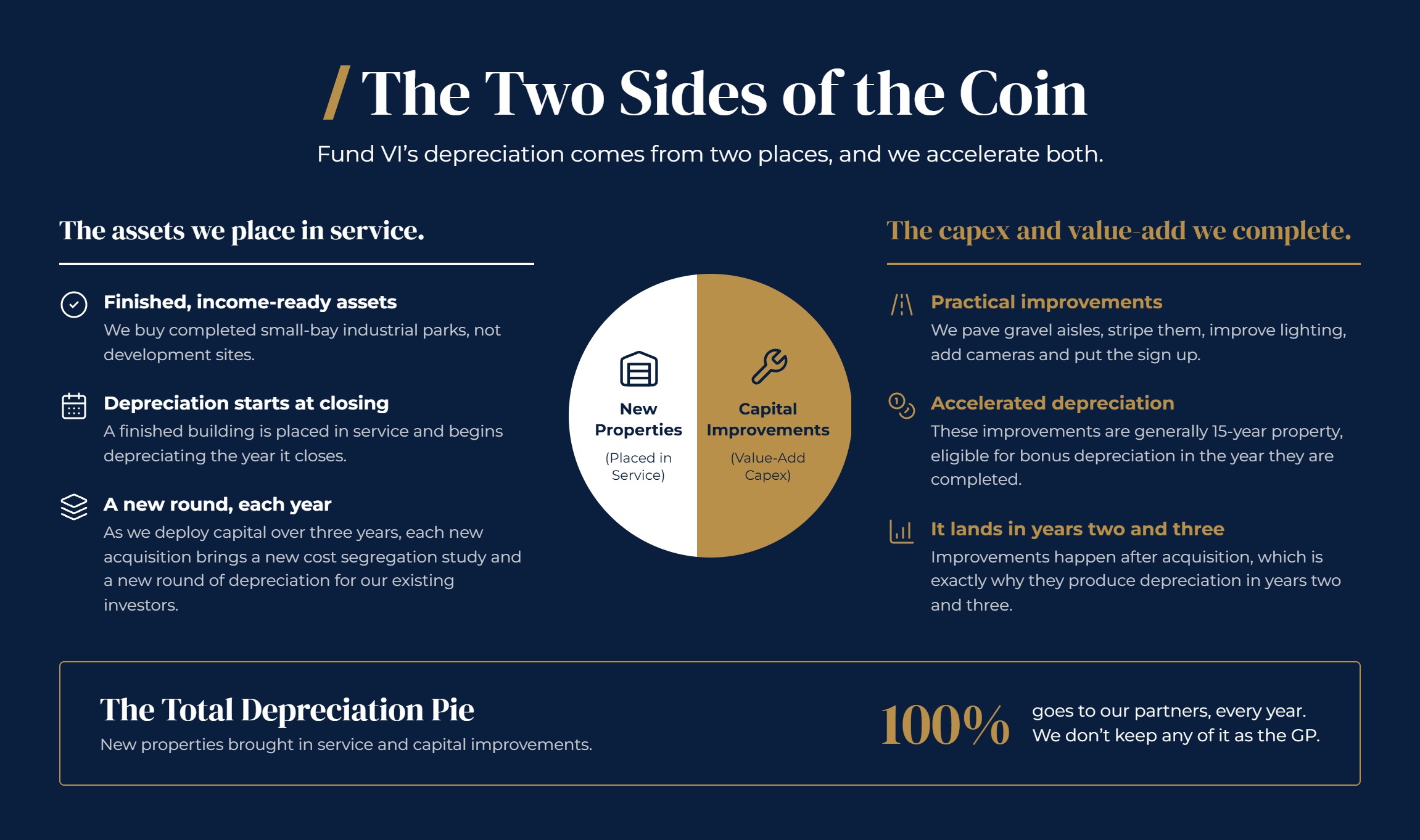
Fund VI's depreciation comes from two places, and we accelerate both.
The assets we place in service. Fund VI buys finished small-bay industrial parks, not development sites. Depreciation can't begin until a property is placed in service, so a finished building starts the year it closes. Our first-close parks in Anna and Melissa, Texas were built in 2024 and 2025. And because Fund VI deploys capital over three years, each new acquisition brings a new cost segregation study and a new round of depreciation for the investors already in.
The capex and value-add we complete. Many of the parks we buy have gravel aisles, poor lighting and no real security. We pave them, stripe them, light them, add cameras and put the sign up. Improvements like these are generally 15-year property, eligible for bonus depreciation in the year they are completed. They land after acquisition, which is exactly why they produce depreciation in years two and three.
Together, that is the total depreciation pie. New properties brought in service and capital improvements. And 100% of it goes to our partners, every year. We don't keep any of it as the GP.
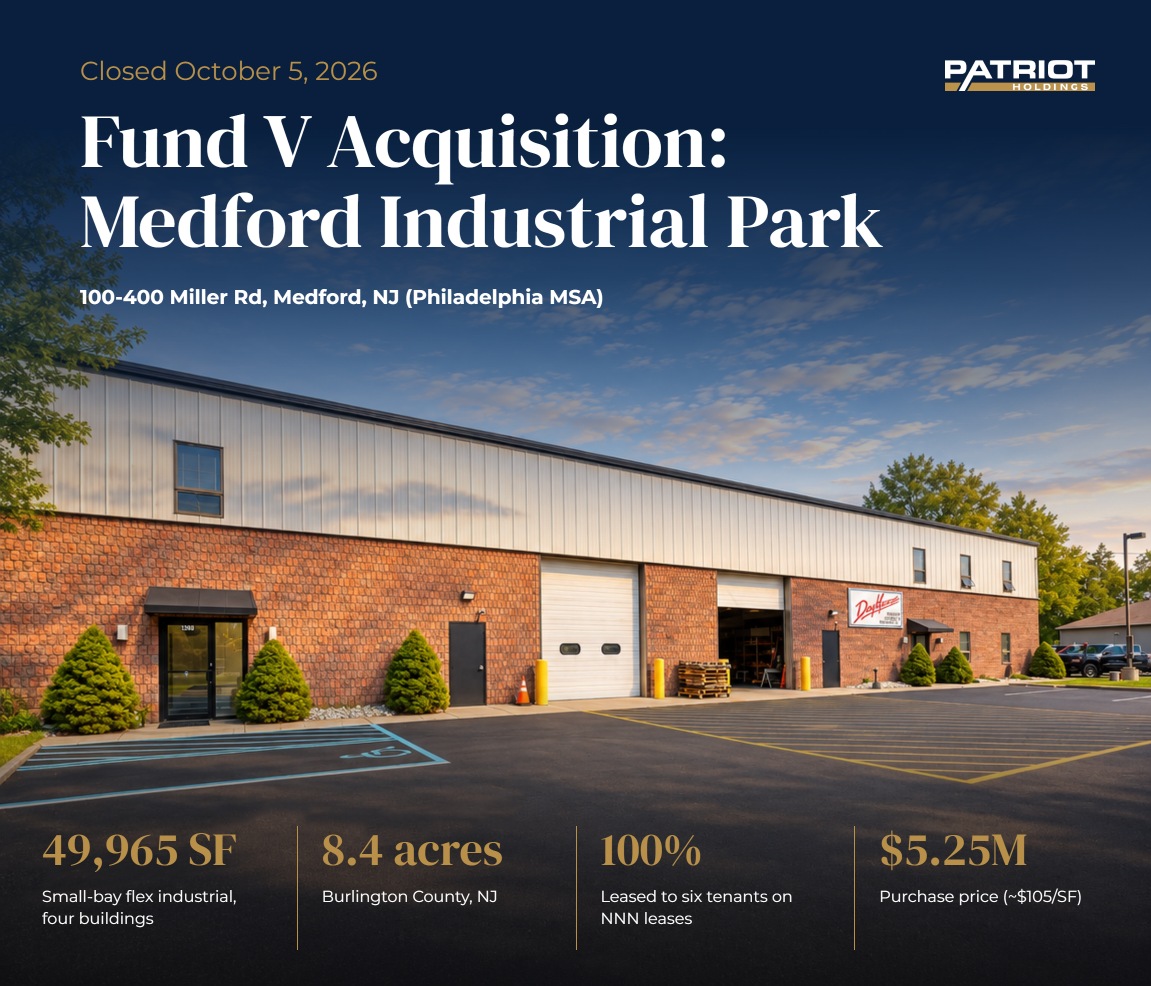
We've seen this play out in Fund V
This isn't theory. Fund V investors who came in during 2025 received $1.04 in losses per dollar invested for 2025. On that same equity, they are expected to receive roughly $0.35 to $0.40 more for 2026, as Fund V continued to place assets in service and complete improvements. Initial 2024 investors in Fund V saw a strong year of losses in 2024, too. Fund VI is structured to make that pattern deliberate, with an equity cap designed around it.
Why we say no to equity
Here is the part that surprises people. We intentionally cap the equity Fund VI accepts in 2026. Every extra dollar we accept dilutes the benefit for everyone already in. So once the cap is reached, we say no, and new commitments roll to 2027. That discipline is what protects the targeted depreciation per dollar.
Why it pays to come in early
Two reasons, in Rick's words: more years of losses per dollar invested, and a higher targeted equity multiple (built on the back of accruing pref longer). 2026 equity is positioned for all three years of targeted depreciation. And because the preferred return accrues from your funding date and early capital enters before the fund is marked to NAV annually, earlier dollars have more time and a lower entry price working for them.
Who this works for
K-1 losses from Fund VI are passive. They can generally offset passive income: rental income, income from other private real estate, or a business you own but don't actively run. They generally cannot offset W-2 wages unless you qualify as a real estate professional. Unused losses generally carry forward. As distributions begin, depreciation can also help shelter them.
The fine print
Depreciation is a timing benefit. It reduces your basis, and when properties sell, it is generally recaptured. The value is keeping more of your capital working now instead of paying it in taxes today. All Fund VI figures in this post are targets, not guarantees, and depend on when you invest, which assets are placed in service, completed improvements and completed cost segregation studies. Fund VI has a targeted seven-year operating period and interests are illiquid.
Three questions investors ask about cumulative depreciation
- Can I really get depreciation in more than one year from the same investment? In a fund that keeps placing assets in service and completing improvements during its deployment period, yes, that is the target. Fund VI targets 75% to 100% in 2027 and 30% to 50% in 2028 on 2026 equity, after roughly 100% to 110% in 2026.
- Is 100% bonus depreciation permanent? Under current law, yes, for qualifying property acquired after January 19, 2025.
- Does the GP keep any of the depreciation? Not at Patriot. 100% passes through to investors every year.
The short version
Fund VI targets 175% to 250% cumulative depreciation per dollar invested over three years, for 2026 equity, by placing finished assets in service and completing improvements across its deployment period, with 100% passed to investors and equity capped to protect the benefit. Whether it fits you depends on your passive income and your CPA's read on your situation.
Want to see what three years of targeted depreciation could look like against your bracket? Model it, then book 20 minutes with Rick.
Explore more:
See your cumulative depreciation
Small-bay industrial parks
Flex industrial real estate blog
We pave them, stripe them, light them - a small-bay case study
COMPLIANCE DISCLOSURE
For informational purposes only. Not investment advice and not an offer to sell or a solicitation of an offer to buy any security; offers are made only through the Fund VI Private Placement Memorandum to verified accredited investors. Fund VI figures are targets, not guarantees. Fund V figures reflect past results; past performance is not indicative of future results. Tax treatment varies by investor; consult your tax advisor. Depreciation is generally recaptured at sale. All investments involve risk, including the possible loss of principal.