Fund V Just Acquired It's Final Asset: Why We Bought the Flex Park Other Buyers Could Not Underwrite
A four-building small-bay park outside Philadelphia came with books no one could read cleanly. We rebuilt them bill by bill, and the numbers held.
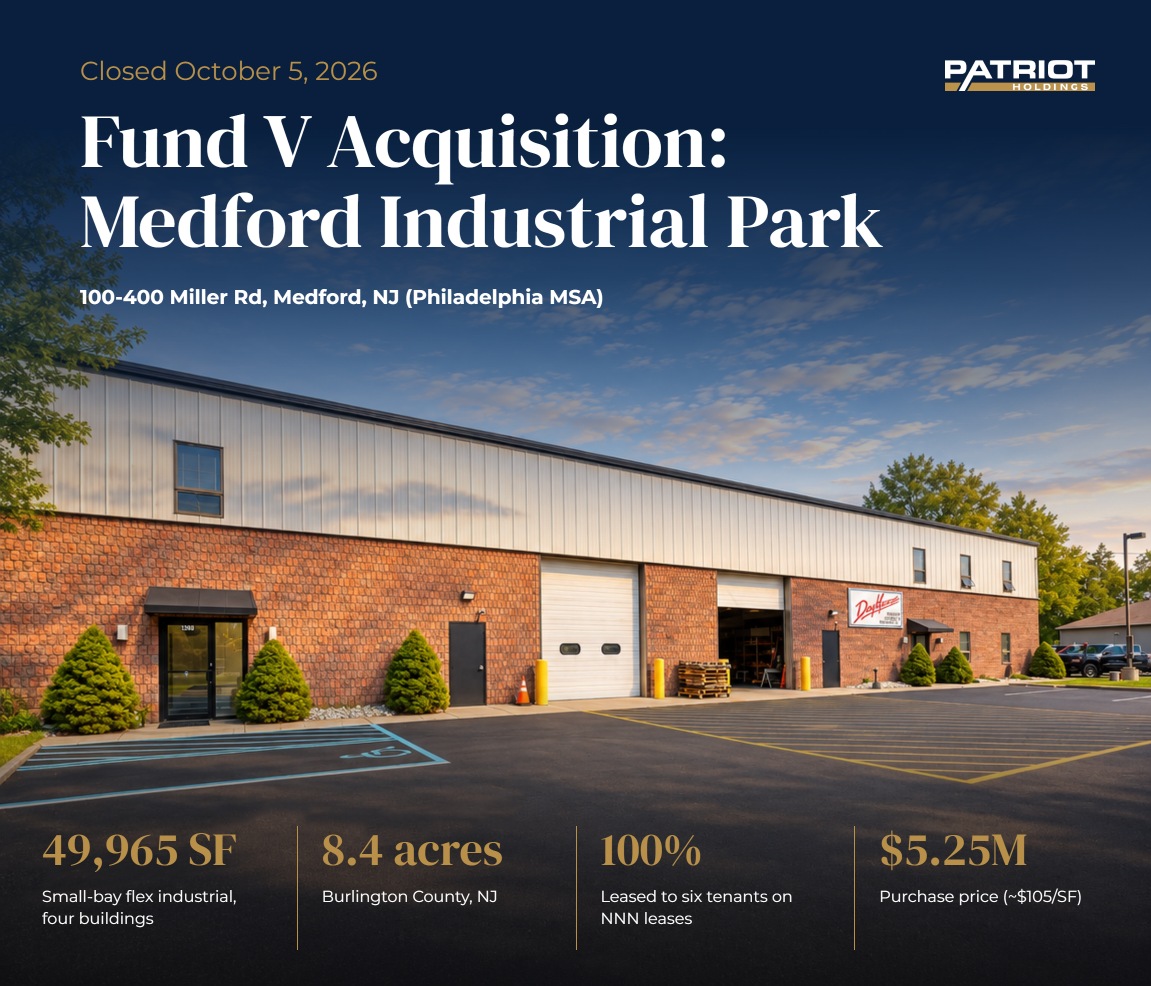
In October, Patriot Holdings closed on a four-building, 49,965 SF small-bay flex industrial park on 8.4 acres in a South Jersey submarket of the Philadelphia MSA. The park is 100% leased to six tenants on triple net leases. Every lease escalates annually, most at 3.0% to 3.5%, and none carries a renewal option. We paid $5,250,000, about $105/SF.
This was not a deal that looked clean on paper. The seller's books were difficult to underwrite, the property sits inside a condominium association, and the tenant roster is concentrated. Here is how we worked through each of those, and why we bought it anyway.
The Deal at a Glance
- Size: 49,965 SF across four buildings on 8.4 acres
- Location: South Jersey submarket, Philadelphia MSA
- Occupancy: 100%, six tenants across eight units
- Leases: triple net (NNN), annual escalators, no renewal options
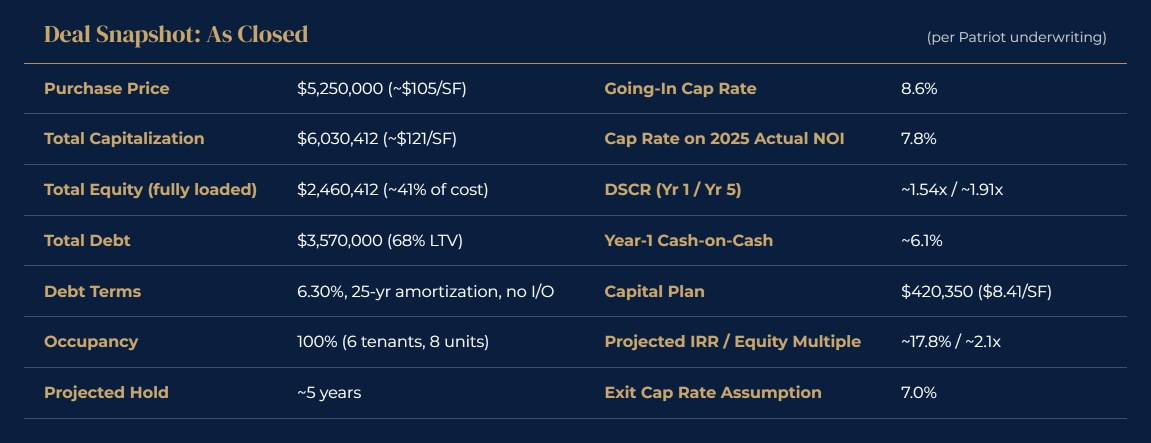
- Purchase price: 5,250,000 (~$105/SF)
- Underwritten NOI: $453,042
- Going-in cap rate: 8.6% on today's leases
Why the Books Kept Buyers Away
The seller was unwinding a position. In May 2025, roughly a year before we went under contract, they sold one of the association's five buildings to a separate buyer and then brought the remaining four to market.
That sequence created two problems for any buyer. First, the association ledger still carried months of expenses, and a distribution from the sale, tied to a building that was no longer part of the deal. Second, rents had never been pushed. One tenant, a flooring contractor, has occupied its suites since 2020 and pays $6.73/SF today, in a market we estimate at $10.00 to $11.00/SF.
Both conditions kept pricing below where a simpler park would trade. Both are also what made the deal work for us.
Rebuilding the Books Bill by Bill
The four buildings are held as condominium units within a five-building association. Patriot owns its four buildings outright and now controls the association, but site-level costs (landscaping, snow removal, trash, water and septic, the master insurance policy and the tax assessment) are billed at the association level and allocated back at roughly a 73% share. Base rent, CAM reimbursements, building insurance, repairs and management sit at the property level.
No single document showed what the four buildings actually cost to run. So our team rebuilt the operating statement line by line: scaling every association cost to our share, backing the sold building out of both sides of the ledger, and reconciling to utility statements, tax bills, trash invoices and vendor contracts.
Operating Statement: Seller 2025 Actuals vs. Patriot Underwriting
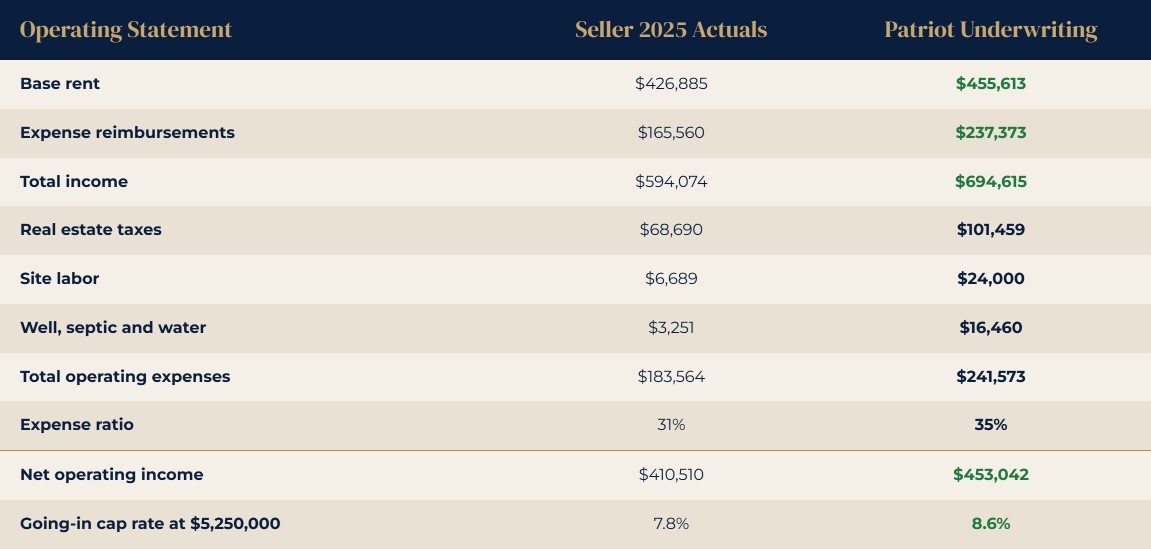
Seller figures are from the offering materials and have not been independently verified. Underwriting figures are Patriot internal underwriting at the $5,250,000 purchase price. Selected expense lines shown; totals include all operating expenses.
Expenses went up meaningfully. Real estate taxes rose 48%. The seller's site labor figure, roughly $0.13/SF, is not a payroll number and ended at closing, so we underwrote real labor. Well, septic and water were underwritten at what three wells, five underground tanks and a pump station actually cost to run.
Income went up by more, and none of that reflects anything missing from the seller's books. For part of 2025, one tenant was on a gross lease, so its share of operating costs was not billed back. Today every lease in the park is triple net. Base rent also reflects two recent signings at higher rates: a new lease with a boutique gym and a renewal with a dance academy.
The Cap Rate Math
Two NOIs, one basis:
- Seller's 2025 actual NOI: $410,510 / $5,250,000 = 7.8%
- Patriot underwritten NOI on today's leases: $453,042 / $5,250,000 = 8.6%
The gap between the two does not assume any future leasing. It reflects leases already signed: every tenant now on triple net and two recent signings at higher rates.
Where We See the Value: Below-Market Rents
In-place rents average $9.12/SF. In our view, the market for this product is $10.00 to $11.00/SF, consistent with the four leases signed in the park between 2023 and 2026 at $10.00 to $11.50/SF. The gap is concentrated in the two largest suites, which together make up about half the rent roll:
- E-commerce tenant (14,400 SF, 28.8% of the park): $7.92/SF through May 2028, underwritten to re-lease at $9.50 to $10.00/SF
- Flooring contractor (10,903 SF, 21.8%): $6.73/SF through March 2030, underwritten to re-lease at $10.00/SF
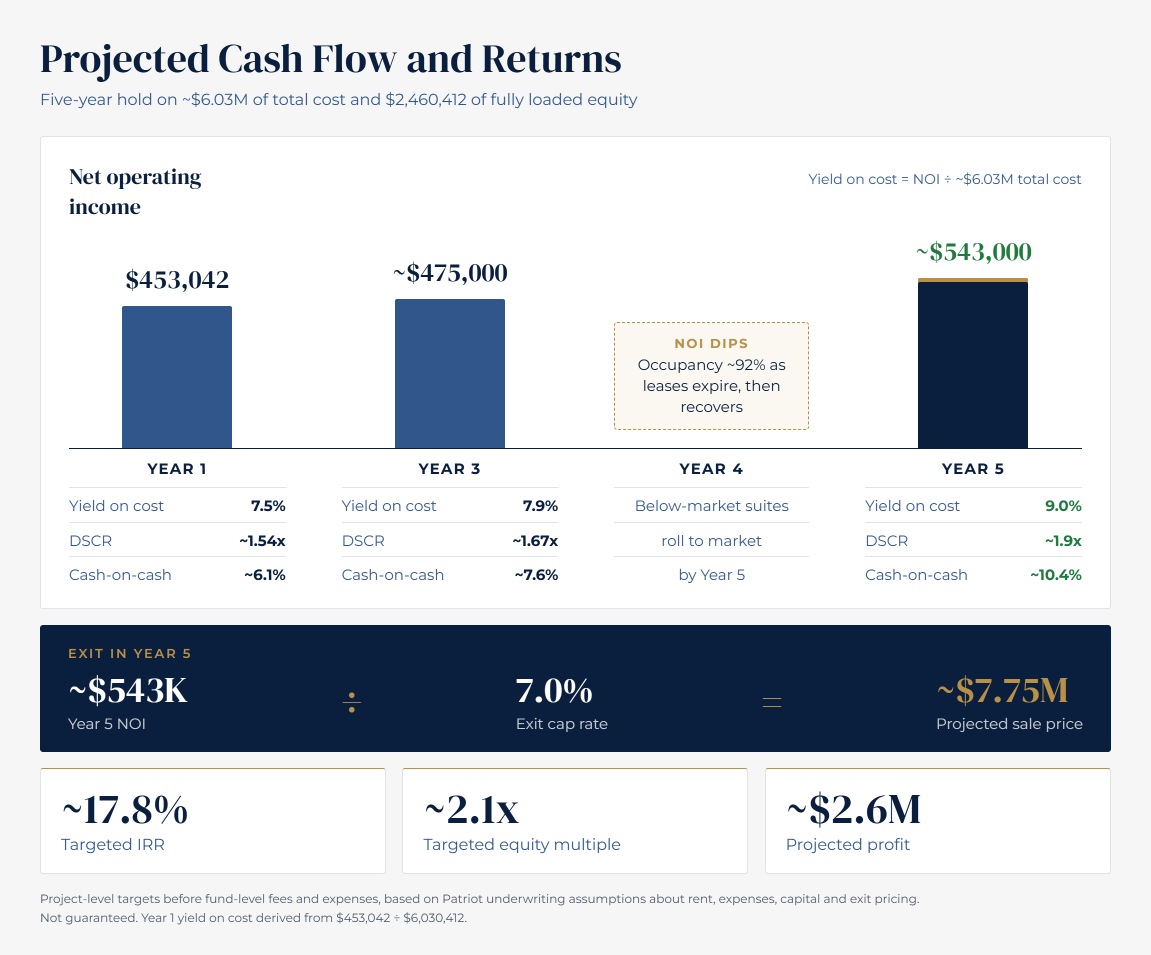
Blended, those two suites pay $7.41/SF today. We deliberately underwrote both at or below the low end of our market estimate. Because no lease carries a renewal option, every expiration is a negotiation with ownership rather than a fixed-rate extension at the tenant's election. These are underwriting assumptions, and they depend on the suites re-leasing at the rents modeled. Within 180 days of any lease expiration, our internal leasing team formalizes discussion with current tenants on lease renewal, and if those conversations do not result in an agreed upon lease renewal at a rate that aligns with the model, we begin formally marketing the units within 90-120 days of lease expiration.
The Risk We Took Seriously: Tenant Concentration
Six tenants is a short list. The largest occupies 28.8% of the square footage, and the top two hold 50.6%. Four of the six are youth sports and fitness businesses: a lacrosse and field hockey turf facility, a competitive fastpitch softball program, a dance academy and a boutique gym. All are tied to discretionary consumer spending. Rollover is front-loaded too: leases covering 44.2% of the space expire in 2028, with another 27.6% in 2029 and 21.8% in 2030.
Tenant count and the condominium structure both sit outside our typical buy box. What got us comfortable is how hard it would be for these tenants to leave.
Three of the six have been in the park five to eight years. The dance academy has been there since 2018 and just re-signed through August 2029 at a higher rate, on a triple net lease. Tenants looking for the exit do not commit to paying more to stay. The sports tenants have built out turf, batting cages and sprung floors that do not easily relocate, in a township where median household income is above $150,000. And we did not assume the leases hand back clean: our model takes occupancy down to about 92% in Year 4 as leases roll.
The Capital Plan
We have budgeted 420,350 (8.41/SF) of capital. Roof work is the largest line at $143,900, followed by $62,500 of septic repair and $45,000 of water treatment. The balance covers monument signage, cameras, a fire alarm panel inspection and paving in the first two years, plus a reserve for paving, stucco repair and mini-split replacements from Year 3 onward. Actual costs may differ from budget. The Phase I environmental assessment did not call for a Phase II, and the site sits outside a flood zone.
Three Questions to Ask Before Buying a Condo-Structured Flex Park
- What does your share of the association actually cost?
In a condominium structure, many site costs never appear on the property P&L. They are billed to the association and allocated back to each owner. Scale every association line to your ownership share and reconcile it to the underlying bills before you trust any NOI figure. - Has a recent sale or ownership change distorted the books?
A mid-year sale can leave expenses, reimbursements and distributions on the ledger for a building that is no longer part of the deal. Back the departed asset out of both income and expenses, or the NOI will be wrong in ways that are hard to spot. - Who controls the lease at expiration?
Renewal options let tenants extend at preset rates, which can cap your ability to move rents to market. Where leases carry no options, each expiration is a negotiation with ownership. That matters most when in-place rents sit well below market.
The Verdict
We bought it. A 49,965 SF, 100% leased, triple net small-bay flex park outside Philadelphia at $5,250,000, about $105/SF, with underwritten NOI of $453,042 for an 8.6% going-in cap rate on today's leases. The books were messy, the structure is unusual and the tenant roster is concentrated. But the rebuilt numbers held, half the park rents well below our market estimate with no renewal options in the way, and the tenants have real reasons to stay. The park is now part of the Patriot Holdings Fund V portfolio.
Want breakdowns like this in your inbox?
Subscribe to the weekly newsletter
To talk through how we underwrite small-bay industrial,
Start The Conversation
About Patriot Holdings
Patriot Holdings is a private real estate investment firm focused on small-bay industrial, self-storage and manufactured housing in secondary U.S. markets. Founded and led by Jeremiah Boucher, the firm brings 17+ years of operating history and $500M+ in transactions across 100+ assets in 18+ states.
This content is shared for educational and informational purposes only. It is not investment advice and does not constitute an offer to sell or a solicitation of an offer to buy any security. Figures reflect Patriot Holdings' underwriting assumptions at the time of acquisition, are subject to change, and are not guarantees of future performance. Forward-looking statements are subject to risks and uncertainties, and actual results may differ materially. Seller figures are drawn from the seller's offering materials and have not been independently verified. Past performance is not indicative of future results. All investments involve risk, including the possible loss of principal.